

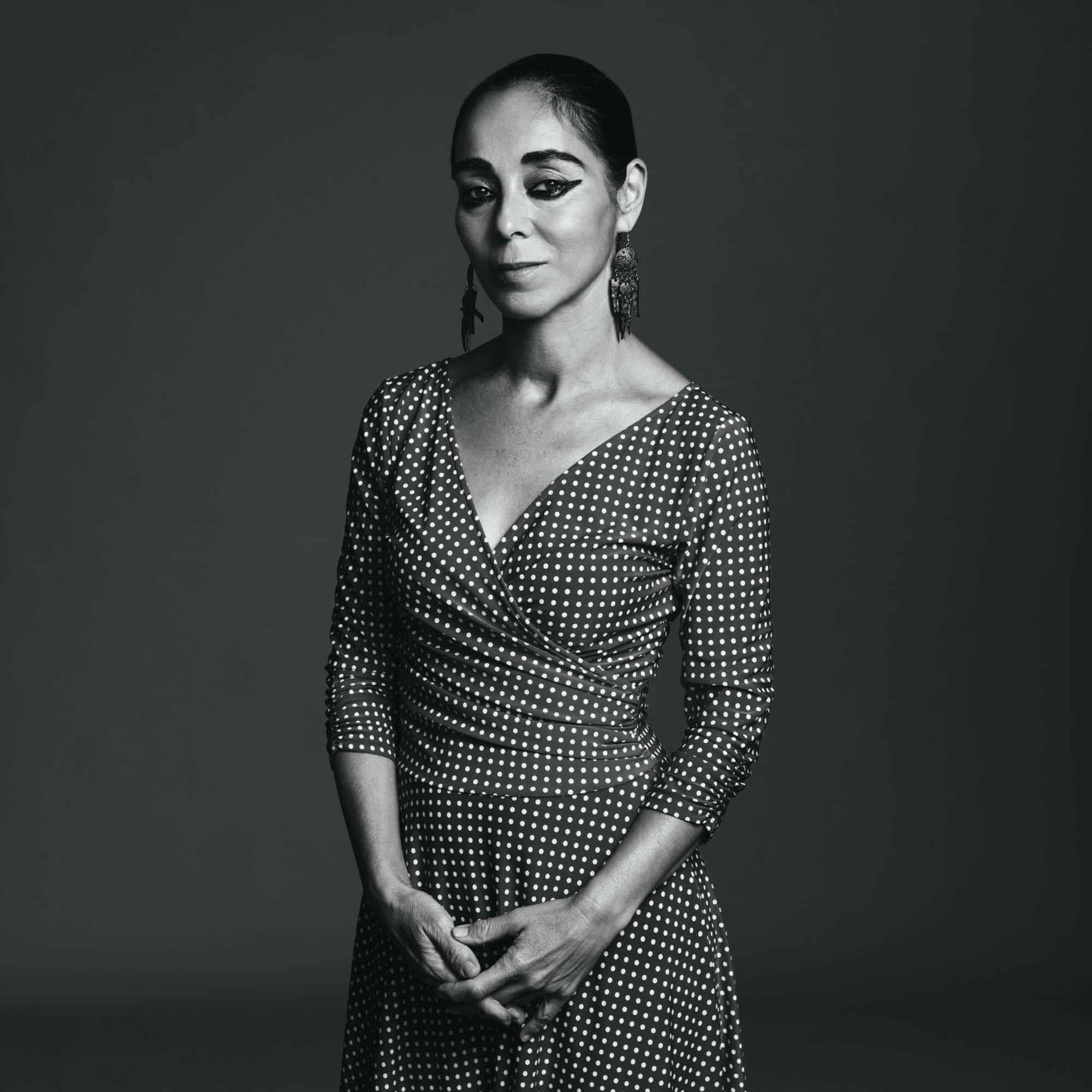
Shirin Neshat is a contemporary Iranian-born photographer and visual artist whose work explores themes of identity, gender, exile, and the intersections of politics and culture. Born in 1957 in Qazvin, Iran, she moved to the United States in 1975 to study art, just a few years before the Iranian Revolution dramatically transformed her homeland. This rupture between her personal history and national identity would later become a central theme in her artistic practice.
After completing her education at the University of California, Berkeley, Neshat remained in the United States, where she developed a multidisciplinary approach that includes photography, video installation, and film. Her early recognition came in the 1990s with the “Women of Allah” series, a body of black-and-white photographs depicting veiled women overlaid with Persian calligraphy. These images confront Western stereotypes of Muslim women while also interrogating the complexities of female identity within Islamic societies.
Neshat’s work is often characterized by its poetic visual language and its blending of beauty with political tension. She uses stark contrasts, such as light and shadow, silence and sound, and male and female perspectives, to evoke emotional and intellectual responses. Her video installations, such as “Turbulent” (1998) and “Rapture” (1999), employ dual screens to present parallel narratives, often highlighting gender divisions and power dynamics in Iranian culture.
In addition to her gallery work, Neshat has directed feature films, including “Women Without Men” (2009), which won the Silver Lion for Best Director at the Venice Film Festival. The film, like much of her work, reflects on historical events in Iran while focusing on the inner lives of women navigating oppression and change.
Living in exile has deeply influenced Neshat’s perspective, allowing her to examine Iran from both an insider and outsider viewpoint. Her art resists simple categorization, instead offering nuanced reflections on displacement, memory, and belonging. Today, she is regarded as an influential voice in contemporary art, with works exhibited in major museums and biennials worldwide.