Ruth Asawa was an American painter and sculptor whose artwork and passion for art education continue to inspire and captivate. She was born in California on January 24, 1926, to Umakichi and Haru Asawa, who had immigrated from Japan. Ruth was one of seven children, and her parents were farmers who grew seasonal crops, which inspired Ruth’s love for the natural world.
Discrimination against Japanese immigrants prevented the Asawas from becoming American citizens or owning land. This, coupled with the difficulties of The Great Depression, caused the Aswas to struggle financially. During World War II, her family was forcibly moved to internment camps, an experience that profoundly influenced her worldview and artistic expression. Despite these hardships, she attended Milwaukee State Teachers College and, later, the prestigious Black Mountain College, NC, where influential artists such as Josef Albers and Buckminster Fuller became her mentors.
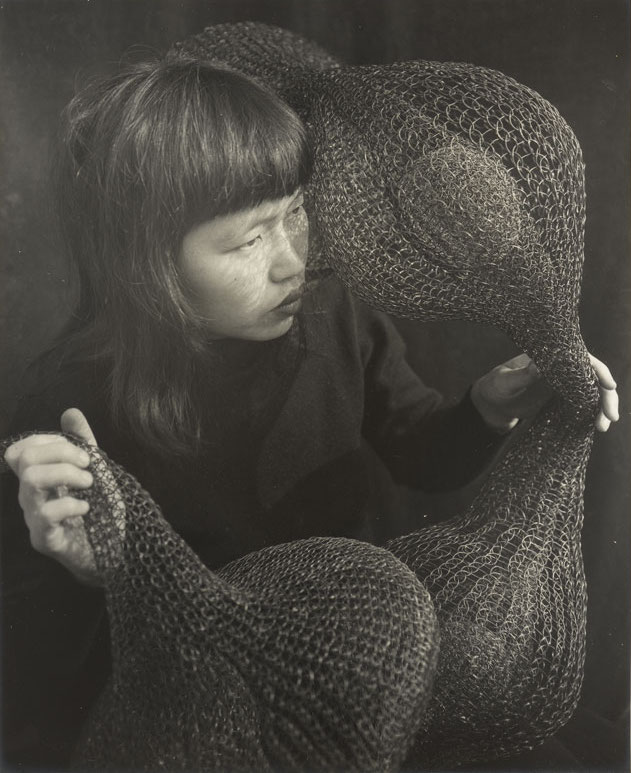
Asawa is best known for her innovative wire sculpture. Her fascination with wire began during a trip to Mexico, where she saw local craftsmen making baskets from the material. She translated these techniques into her art, using wire to create intricate, 3–D forms that defied conventional artistic boundaries.
In the 1950s, Asawa’s work gained recognition. Her pieces were shown in prestigious galleries, and she became a prominent figure in the San Francisco Bay Area art scene. However, Asawa’s contributions extended far beyond her studio. She was deeply committed to arts education and believed in the transformative power of creativity. As an advocate for arts education, Asawa passionately believed that art should be accessible to all, regardless of socio-economic status. Her tireless efforts led to the creation of the Ruth Asawa School of the Arts in San Francisco, a public high school that offers a comprehensive arts education program to talented students.
Throughout her life, Ruth Asawa’s commitment to social justice was unwavering. She actively participated in the civil rights movement, using her art to address issues of race, identity, and equality. Her wire sculptures served as a means of expressing her vision of interconnectedness and inclusivity. Ruth Asawa died at age 87 in 2013, leaving behind a rich legacy of artistic achievement and advocacy.