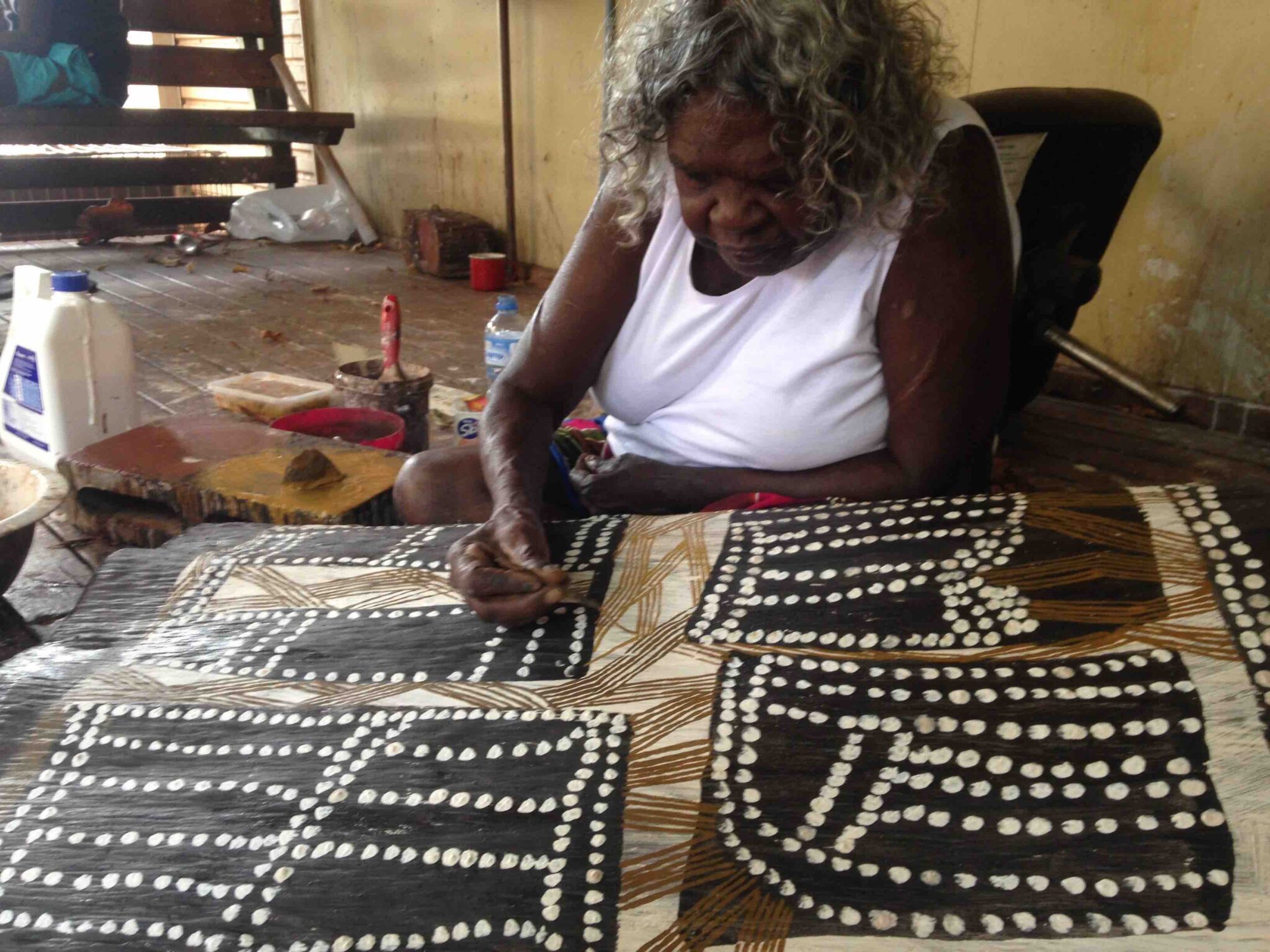
Nonggirrnga Marawili (1939–2023) was a celebrated artist from the Madarrpa clan of Northeast Arnhem Land in the Northern Territory of Australia. Known for her powerful and innovative bark paintings, larrakitj (memorial poles), and works on paper, Marawili’s art expressed deep connections to ancestral stories, clan law, and the natural world, particularly the sea and lightning that define her coastal homeland.
Born on the beach at Darrpirra near Djarrakpi (Cape Shield), Marawili was immersed from birth in the rich cultural and artistic traditions of her people. Her father, Mundukul (also known as Djirrawunu), was a renowned bark painter, and his influence can be seen in her early works. However, she gradually developed a highly individual style that blended traditional iconography with contemporary abstraction.
Marawili worked for many years assisting her husband, the late artist Djutadjuta Mununggurr, before beginning her solo artistic career later in life. Her work gained recognition through Buku-Larrŋgay Mulka Centre in Yirrkala, where she became a leading figure. Her art was deeply rooted in Madarrpa law and the elemental forces of her environment—lightning, water, fire, and rock—often depicted in a distilled, expressive visual language using natural ochres and limited palettes.
Her striking compositions and fearless innovation garnered national and international acclaim. In 2015, she won the Bark Painting Award at the National Aboriginal and Torres Strait Islander Art Awards, and in 2019, she was a finalist for the prestigious Hadley’s Art Prize. Her work has been exhibited widely, including at the Art Gallery of New South Wales, the National Gallery of Australia, and internationally in the United States and Europe.
Despite her success, Marawili remained grounded in her Yolngu identity and cultural responsibilities. Her paintings were not only artistic expressions but acts of cultural continuation, asserting the vitality of Yolngu law in a contemporary context.
Nonggirrnga Marawili passed away in 2023, leaving behind a profound legacy as one of Australia’s most important Indigenous artists. Her art continues to inspire new generations and holds a lasting place in the story of contemporary Australian art.