Monir Shahroudy Farmanfarmaian (1922–2019) was a pioneering Iranian artist renowned for her innovative use of geometric abstraction and mirror mosaics. Her work represents a fusion of traditional Persian art with contemporary artistic practices, making her a distinctive figure in the world of modern art.
Born in Tehran, Farmanfarmaian was deeply influenced by the rich cultural heritage of Iran. Her early education in fine arts began at the University of Tehran, where she was exposed to a variety of artistic techniques. However, it was her move to New York in the late 1940s, where she furthered her studying at Cornell University, Parsons School of Design, and the Art Students League, that led to the development of a unique blend of traditional Persian art and Contemporary styles. She became an important fixture of the New York art scene, befriending important painters such as Andy Warhol, Jackson Pollock, and Joan Mitchell.
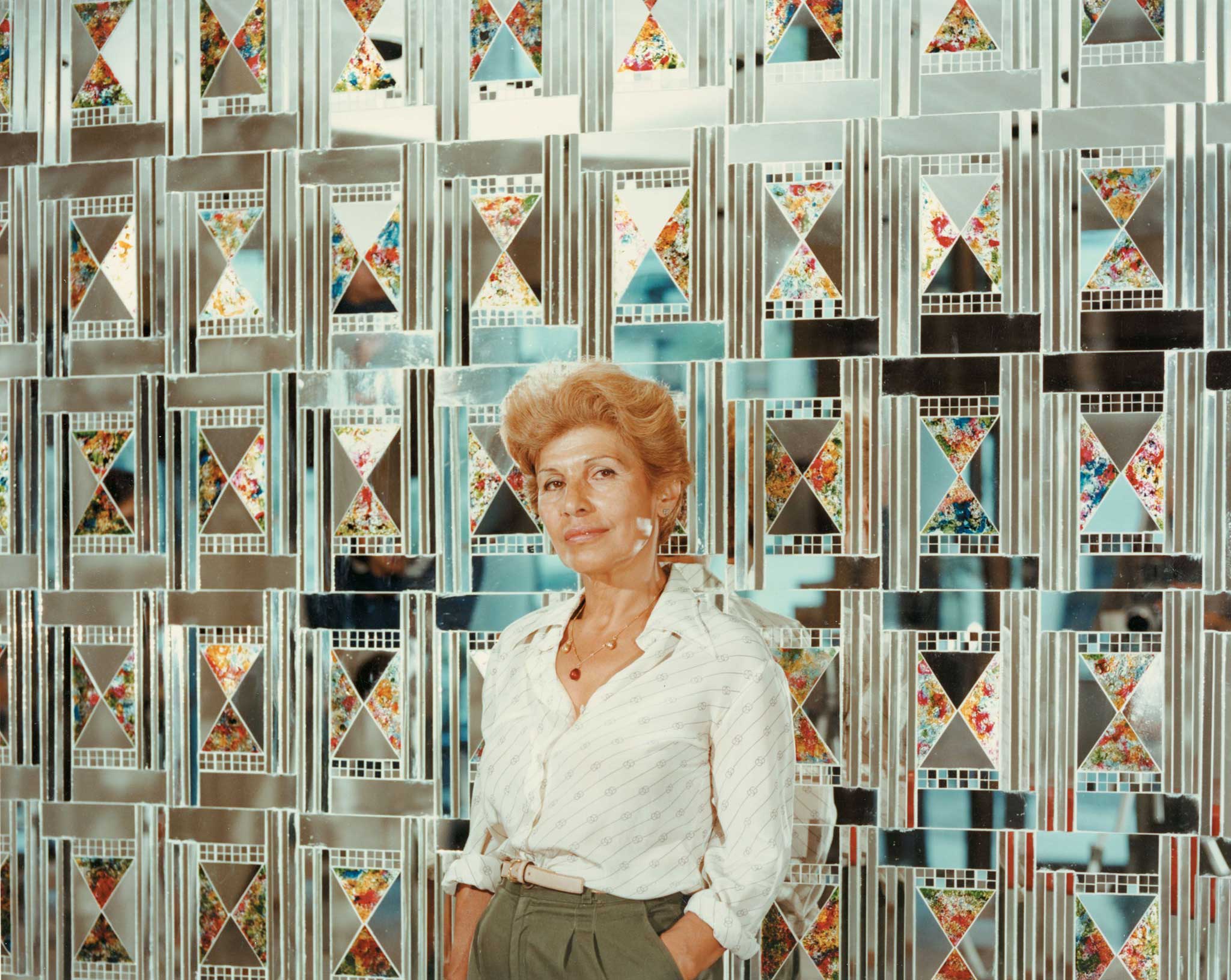
Farmanfarmaian’s signature style emerged from her fascination with Islamic art, particularly its intricate geometric patterns and the use of mirrors. She employed these elements to create striking visual compositions that blended the spiritual and the contemporary. Her mirror mosaics are perhaps her most celebrated contributions to art. These works, characterized by their reflective surfaces and geometric precision, not only draw from traditional Persian tile work but also engage with the reflective and transformative qualities of modern art.
One of Farmanfarmaian’s notable achievements was her ability to bridge cultures. Her work often reflects a dialogue between Eastern and Western artistic traditions. By integrating Western modernist principles with traditional Persian motifs, she created a unique hybrid that resonated with audiences around the world. Her approach was both respectful of her cultural heritage and innovative in its use of materials and techniques.
Throughout her career, Farmanfarmaian exhibited her work internationally, earning acclaim for her contributions to contemporary art. Her pieces have been displayed in prestigious venues such as the Museum of Modern Art in New York and the Venice Biennale. In the midst of this recognition, she remained deeply connected to her roots, continually drawing inspiration from Persian history and culture.
Farmanfarmaian’s legacy is one of artistic innovation and cultural synthesis. Her ability to blend traditional Persian art with contemporary practices demonstrates the power of art to transcend boundaries and foster cross-cultural understanding. As a result, she remains a significant figure in both the Iranian and global art scenes, celebrated for her distinctive vision and enduring influence. Her work continues to inspire new generations of artists and art lovers, reflecting the timeless dialogue between tradition and modernity.