Maria Sol Escobar was born in 1930 to Venezuelan parents living in Paris. As a child, she displayed a talent for both drawing and embroidery, and her parents encouraged her creative work. Her family often traveled between Europe, the United States, and Venezuela, and in 1946 they permanently relocated to Los Angeles, where Maria began her formal arts education at the Otis Art Institute. A few years later, she studied at both the École des Beaux-Arts in Paris and the Art Students League of New York, where she was a student of Hans Hofmann.
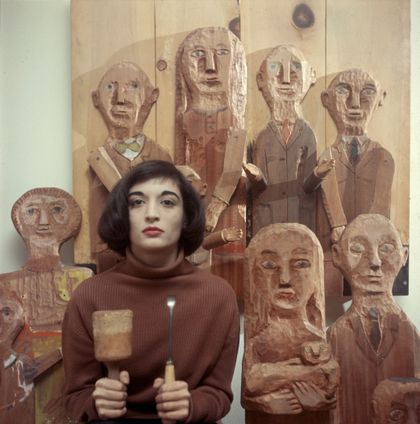
In the late 1950s, Maria began exhibiting in New York under the name Marisol, and quickly became a prominent and unique voice in the New York art scene. Influenced by the assemblage work of her contemporaries, as well as pre-Columbian sculpture and the craft that she learned as a child, Marisol developed a style that had a substantive theatricality while simultaneously maintaining the whimsy and accessibility characteristic of folk art. Her pieces were mixtures of carved sculptural elements, paintings, drawings, and photography, as well as assemblage.
The content of Marisol’s work was an exploration of heritage, celebrity, and the malleability and solidity of societal and familial roles, but her natural disposition lent itself to the gravitational pull of the performative elements of her peers, like her friend Andy Warhol. Her style and demeanor enchanted the press and the public, though she remained elusive and opaque. She spoke rarely, and when she did, she used as few words as possible, adding a mysterious quality to the persona that accompanied her artistic appeal.
Although she had widespread notoriety early in her career and exhibited with Jasper Johns and Robert Rauschenberg, and at MoMA, the Venice Biennale, and documenta in Germany, Marisol’s work and influence were almost forgotten by the art world during her self-imposed, multi-year breaks from the public eye. Her work then turned surreal, mythic, and sometimes thematically foreboding. In her later years and after her death in 2016, critics and curators recognized the profound impact of Marisol’s work in her time, and the prominence of her continually reverberating artistic voice.