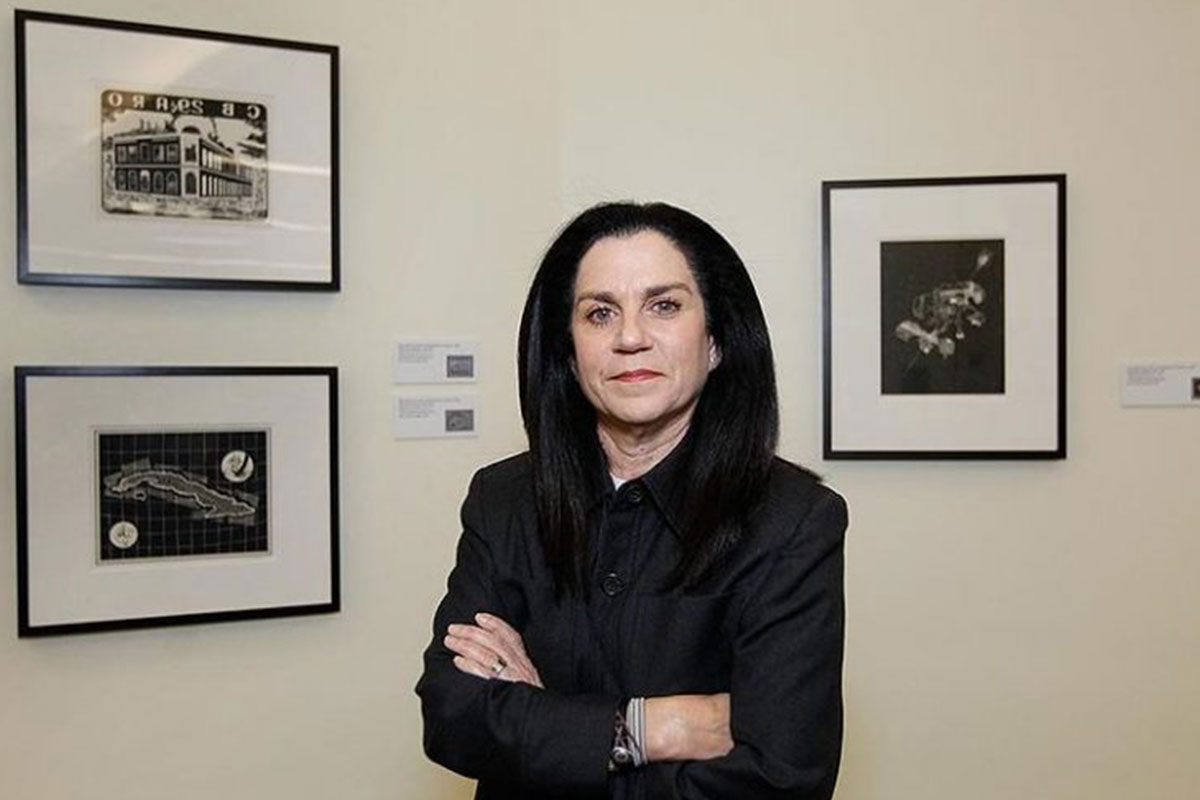
María Martínez-Cañas’s Cuban-American identity influences much of her experimental photography and assemblage artwork. Born in Havana, Cuba, Martínez-Cañas moved with her family to Miami when she was just a few months old, then to Puerto Rico. When she was eight, her parents gave her a Polaroid Swingerlater and built a darkroom in their home, as her interest in the art and science of photography grew.
Martínez-Cañas began her career in 1977 with her first photography exhibition, Reflejos, in San Juan. The following year, she entered the Philadelphia College of Art, where she began to experiment with photography. Shortly after receiving her MFA from the School of the Art Institute of Chicago in 1984, she received a Fulbright-Hays Fellowship to photograph and conduct research in Spain relating to Columbus’s exploration and colonization of Cuba. In 1986, she returned to the U.S. and settled in Miami.
Martínez-Cañas’s career has been driven by experimentation with different photographic techniques, moving beyond the documentary use of photography to a visual poetry using drawing, collage, and photo montage. Similarly, she has explored the technology of photography, from analog to digital, color to black-and-white, and cameras to photograms, as well as experimented with the printing process, utilizing stains, saliva, and onion skin, and printing photographs onto tapestry, newsprint, and vellum.
Much of her work also centers on her Cuban, Puerto Rican, and mainland American identities. She has often used maps, family photographs, and historical art images to consider the history of Cuba and Puerto Rico. Her more recent work, including series such as Lies (2005), Adaptation (2006), Tracing (2007), and Duplicity as Identity (2008–2009), continued to push the limits of photography and interrogate the camera’s ability to reveal, hide, and confuse.
Martínez-Cañas has been the recipient of many awards and grants, including a National Endowment for the Arts grant and a Civitella Ranieri Foundation fellowship in Umbertide, Italy. Her photographs are in private and public collections, including the Lowe Art Museum at the University of Miami and the Whitney Museum of American Art in New York City.