
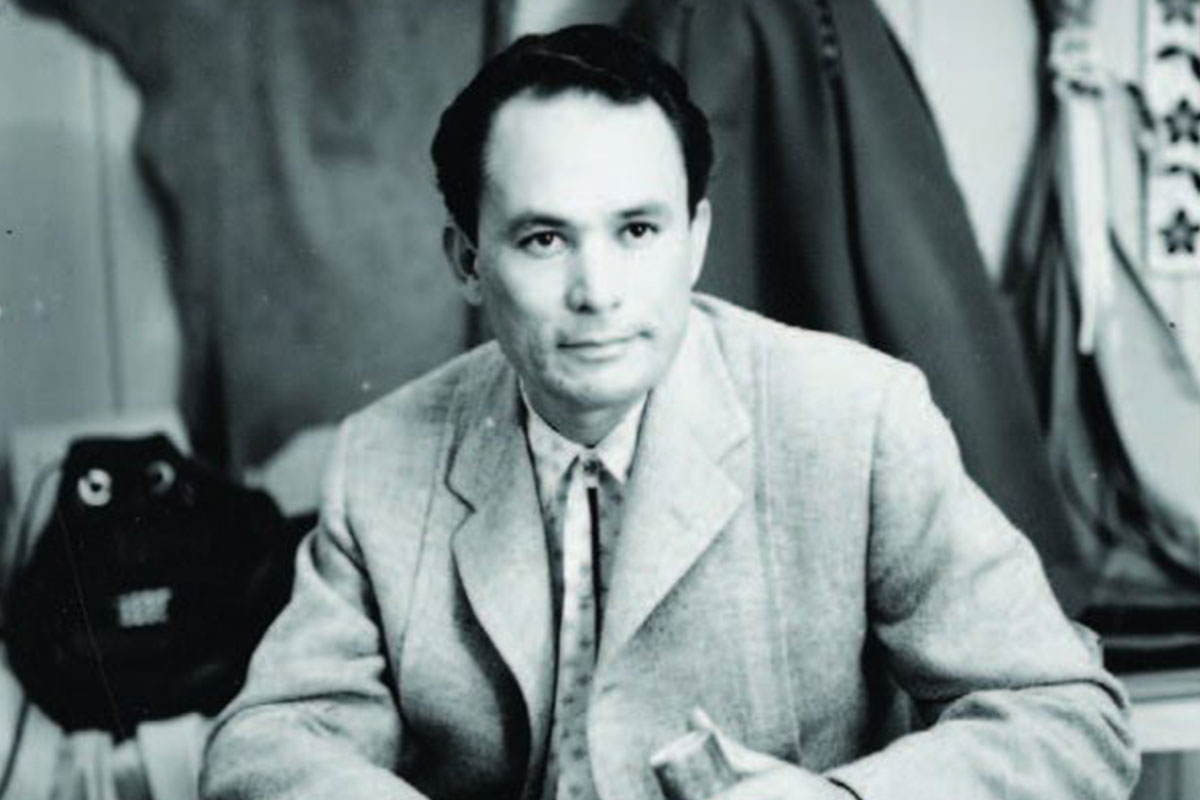
Lloyd Henri “Kiva” New (1916–2002) is best known as an innovator of Native Modernism through his fashion and textile design, and as an arts educator who developed culturally-based arts education for Native students. New grew up in Oklahoma, the son of Cherokee and Scots-Irish parents. In 1938, he earned a degree in art education from the Art Institute of Chicago and then taught painting at the Phoenix Indian School, AZ. In 1941, he enlisted in the Navy and served on the USS Sanborn in the Pacific theater during World War II.
After the war, New returned to Arizona and became a charter member of the Arizona Craftsmen cooperative, a group of artists who helped develop Scottsdale, AZ, into a western center of handcrafted arts. In 1946, he took the trade name Kiva and established the Lloyd Kiva Studio, where he collaborated with other Native artists to create handbags, clothing, and printed textiles. At a time when Native cultures were still being restricted and relocated, New earned national acclaim for incorporating design concepts and materials from various Native American tribes to create items that would appeal to Native as well as non-Native consumers. In 1951, he became the first Native American to show at an international fashion show.
In 1961, New became the first art director at the newly formed Institute of American Indian Arts (IAIA) in Santa Fe, NM. The school is one of 37 tribal colleges in the U.S. and was initially a high school formed under the Department of Interior’s Bureau of Indian Affairs. New and the other predominantly Native American faculty encouraged students to rediscover their own heritage and share it with others, while not being bound by tradition. New became director of IAIA in 1967 and was at the helm in 1975, when the school became a two-year college.
After his retirement in 1978, New remained involved in the Native arts community, including serving as an adviser on the creation of the National Museum of the American Indian in Washington, DC. In 2000, he was awarded an honorary doctorate by the Art Institute of Chicago.