

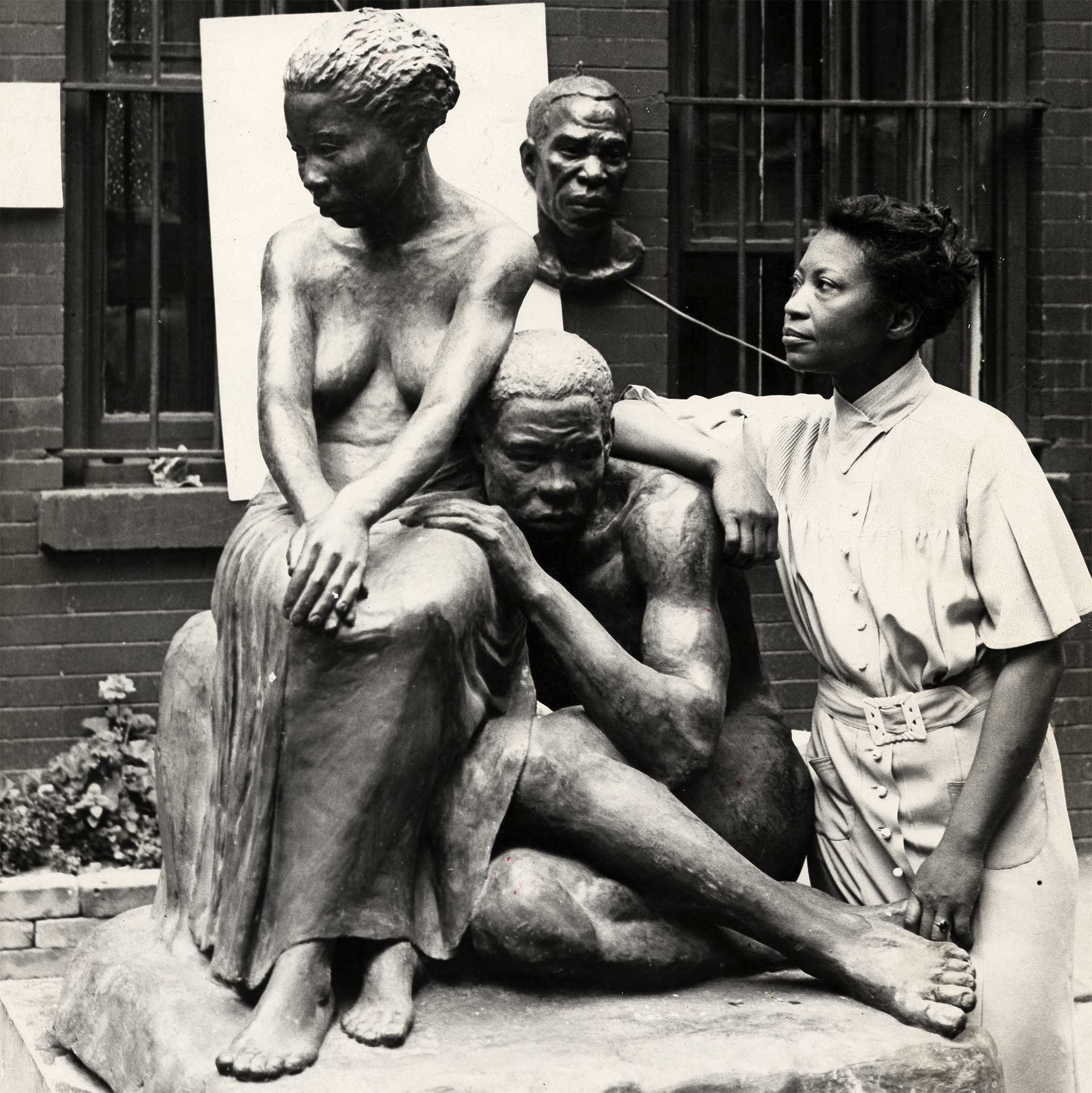
Augusta Savage (1892–1962) was a sculptor of the Harlem Renaissance who blended activism and art and served others as an educator and community organizer. She was born in Green Cove Springs, FL, a brick-making town with natural red clay that she used to create figures as a child, despite the disapproval of her father. “He nearly whipped all the art out of me,” she later recalled.
Fortunately, a teacher encouraged her to continue, and in 1921, with only $4.60, she moved to Harlem, NY, where she worked as an apartment caretaker and studied at the Cooper Union for the Advancement of Science and Art. In the mid-1920s, during the height of the Harlem Renaissance, Savage earned a reputation as a portrait sculptor. Her best-known work during this time was Gamin, a bust of her nephew, which was remarkable in part for presenting a Black child realistically and humanely. The bust helped earn Savage fellowships and a grant to study and travel in Europe.
Upon her return to Harlem, she established the Savage Studio of Arts and Crafts and became an influential teacher. In 1935 she said, “If I can inspire one of these youngsters to develop the talent I know they possess, then my monument will be in their work.” She became the first African American elected to the National Association of Women Painters and Sculptors in 1934 and the first director of the Harlem Community Art Center in 1937.
Savage was commissioned by the 1939 New York World’s Fair to create a sculpture symbolizing the musical contributions of African Americans. The Harp, her largest work and last major commission, was inspired by the lyrics of James Weldon Johnson’s poem “Lift Every Voice and Sing.” The piece was cast in plaster finished to resemble black basalt and received much acclaim. However, no funds were available to cast or store it, so The Harp was destroyed after the fair closed. Unfortunately, most of the rest of Savage’s work has also been lost or destroyed, but her known work and her story continue to resonate.