



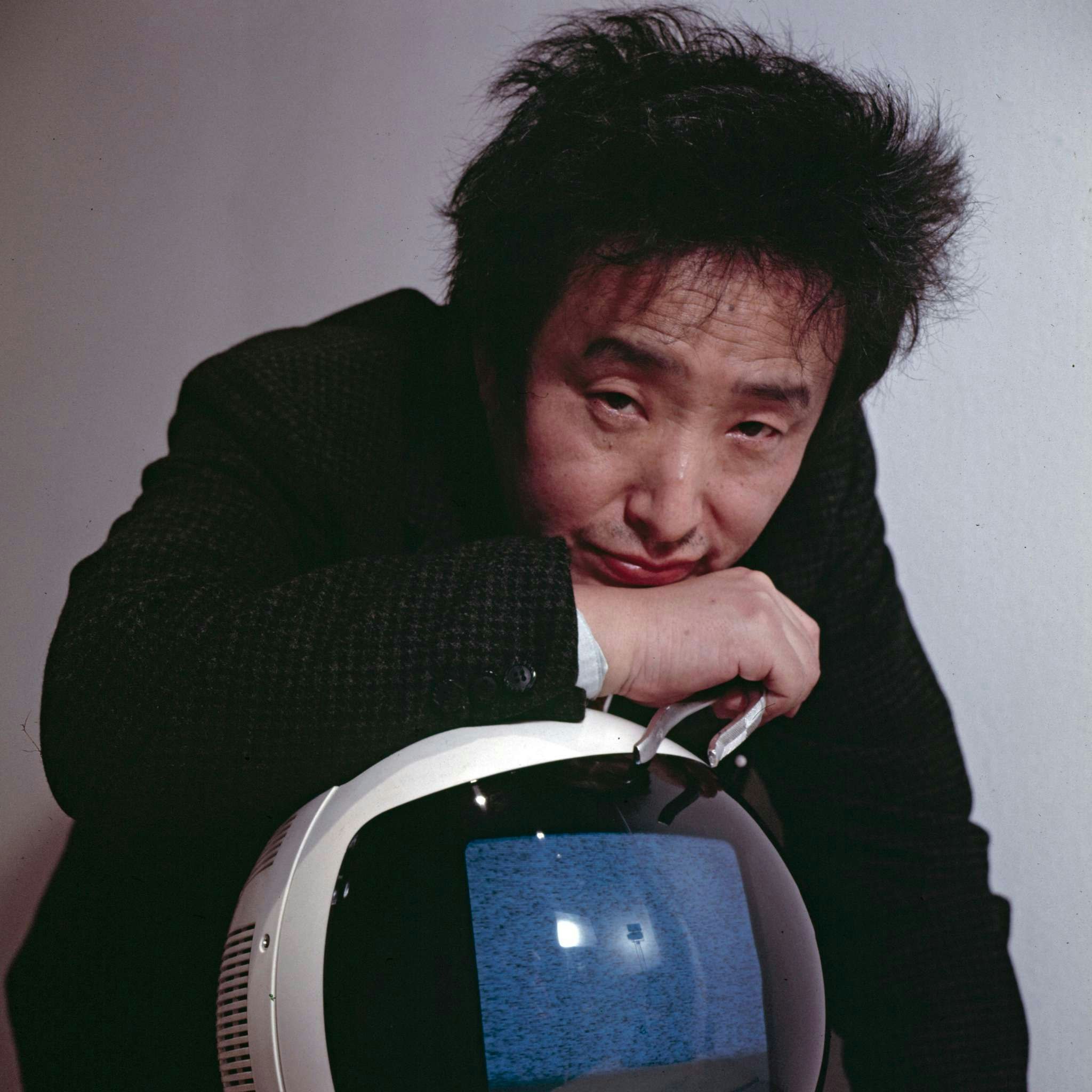
Nam June Paik (1932–2006) was a pioneering Korean American artist, widely regarded as the father of video art. Born in Seoul, South Korea, Paik grew up during a tumultuous time in history, experiencing the impacts of the Korean War and its aftermath. He initially studied music at the University of Tokyo, where he began to explore avant-garde and experimental forms of art, blending his love for music with visual expression.
Paik’s journey into the realm of video art began in the early 1960s, when he moved to the United States and became involved with the New York City avant-garde art scene. In 1965, in his first solo exhibition in New York, he exhibited Magnet TV, which involved a magnet attached to a television screen to distort its image. This piece was a catalyst for further developing his belief that media and technology could be manipulated and redefined to broaden the scope of their production.
In 1969 Paik created TV-Bra for Living Sculpture, a work that involved placing a television set on the body of a performer. This work, along with his involvement in Fluxus, an international network of artists focused on experimental art and performance, laid the foundation for his future innovations in the use of television, video technology, and performance as synthesized artistic mediums.
One of Paik’s most iconic works, Good Morning, Mr. Orwell (1984), was a satellite television broadcast that linked artists and musicians from around the world. This further cemented his role as a visionary in the digital age, envisioning a network of artists and collaborators we see so prominently today.
Nam June Paik’s work was defined by his ability to merge technology with artistic expression. Throughout his career, he explored themes such as the relationship between art and technology, media influence, and the impact of television on society. His groundbreaking contributions to the art world earned him numerous accolades, and his legacy continues to inspire contemporary artists working with technology and video.