
El Anatsui is a renowned contemporary artist celebrated for his groundbreaking work in sculpture and installation art. Born in 1944 in Ghana, Anatsui’s grew up in a society rich in history and artistic heritage. His early exposure to traditional Ghanaian culture and craftsmanship developed his appreciation for art’s ability to convey cultural narratives. After completing his early education, Anatsui pursued art studies at the College of Art at the Kwame Nkrumah University of Science and Technology in Kumasi, Ghana. This academic foundation laid the groundwork for his future exploration and experimentation with various artistic forms.
In the 1970s, Anatsui accepted a teaching position at the University of Nigeria in Nsukka, where he was exposed to new perspectives, materials, and artistic movements. Anatsui’s early works in Nigeria were deeply rooted in the traditions of woodcarving, a craft he had mastered during his formative years in Ghana. Over time he began to experiment with a diverse range of materials, incorporating found objects and discarded materials into his sculptures. This marked a crucial shift in his artistic approach, foreshadowing the innovative techniques that would later define his practice.
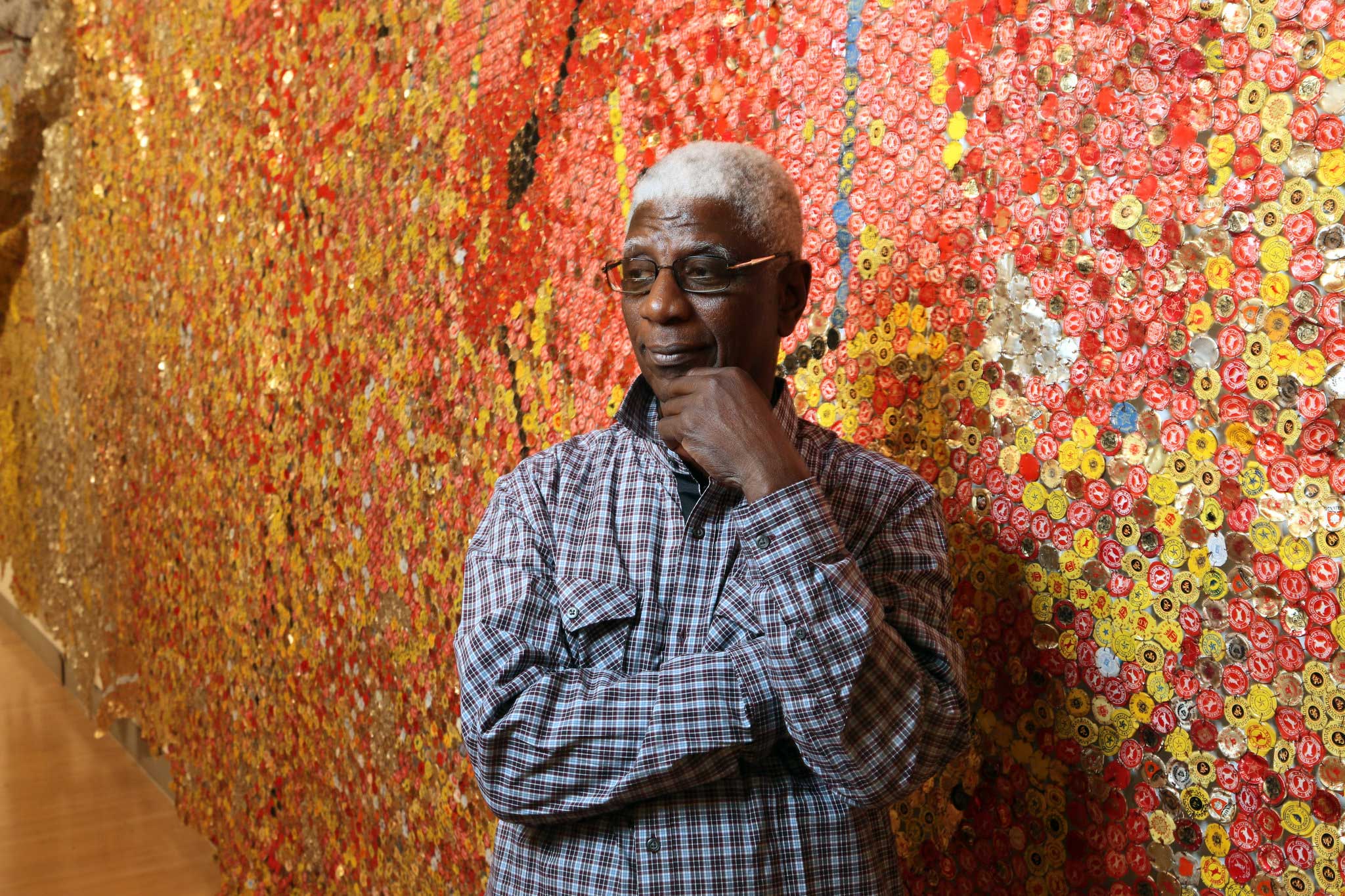
The turning point in Anatsui’s career came in the late 1990s when he started using discarded aluminum bottle caps to create large-scale, shimmering tapestries. These works, often described as “cloth-like” or “metal fabrics,” challenge conventional notions of sculpture and drew attention to the potential of overlooked materials. Anatsui meticulously links together thousands of aluminum pieces, allowing them to cascade and fold, creating monumental, fluid compositions that evoke both textile traditions and contemporary concerns. By using such a ubiquitous, discarded material, one can infer a dialogue about environmental concerns, substance abuse, or a general observation of the multiplicity of seemingly useless material waste.
El Anatsui’s influence extends far beyond the confines of his studio. As an educator, he has inspired countless students with his passion for experimentation and his commitment to the transformative power of art. His works have been exhibited in major art institutions worldwide, from the Venice Biennale to the British Museum, solidifying his place as a significant voice in the contemporary art world.