


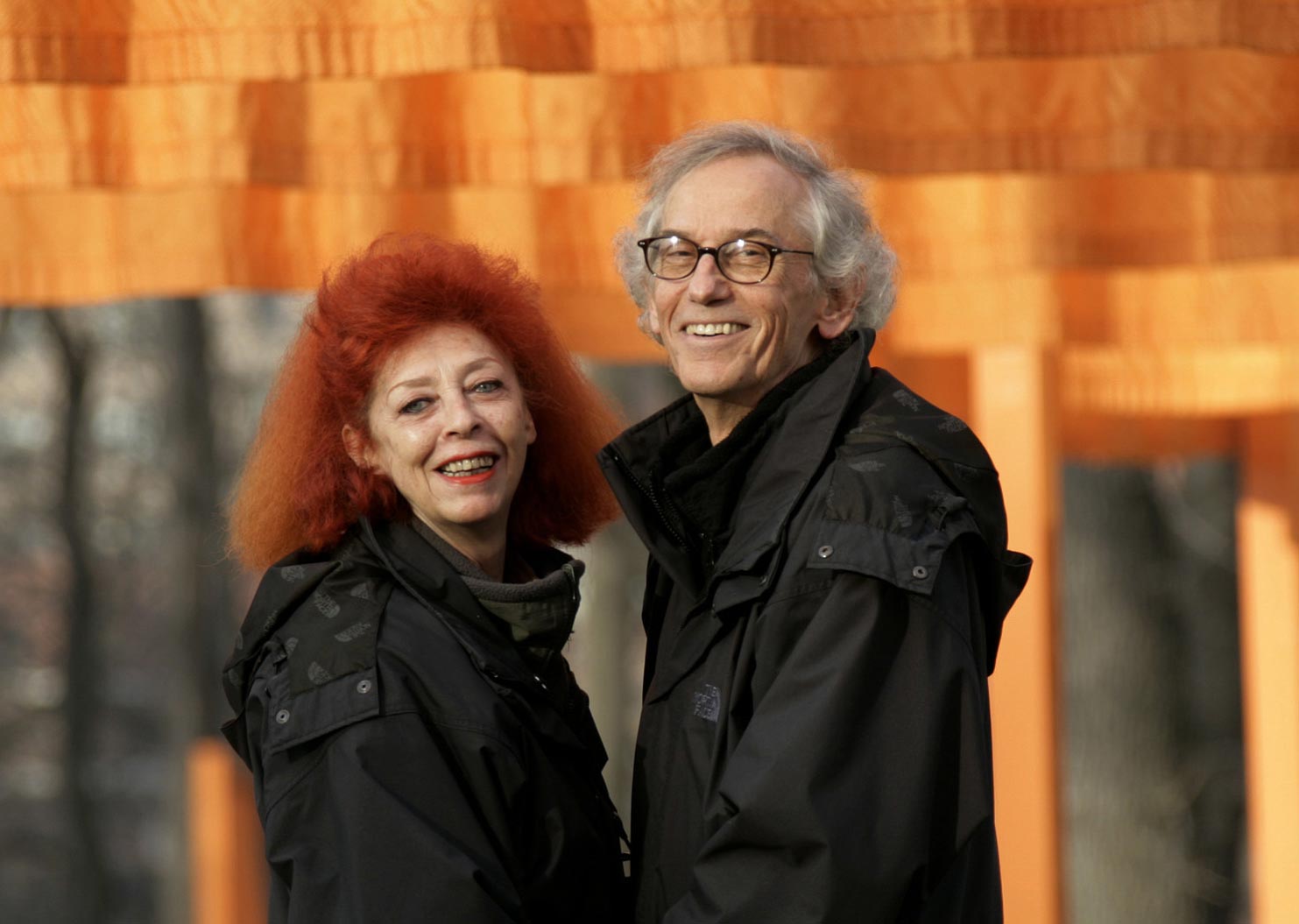
Christo Vladimirov Javacheff (1935–2020) and Jeanne-Claude Denat de Guillebon (1935–2009)—often known simply as Christo and Jeanne-Claude—were artists whose immense site-specific environmental installations captured the public’s attention. From installing 3,100 self-standing umbrellas for an installation that encompassed parts of both Japan and California to wrapping the Reichstag building in Berlin with 100,000 meters of silver fabric and blue rope, Christo and Jeanne-Claude attracted millions of visitors to their elaborate installations.
Trained as a painter in his homeland of Bulgaria, Christo eventually abandoned painting after encountering modern and avant-garde methods of artmaking. In 1958, he made the first of his wrapped objects, a fabric-wrapped paint can. This began a project that he called his Inventory: everyday objects obscured by concealment.
Christo and Jeanne-Claude met around this time, and soon after they began their partnership, both as a married couple and an art-making duo. Jeanne-Claude was an extrovert with gifted organizational skills. She oversaw project logistics and fundraising, balancing Christo’s spontaneity and whimsy, and making them an incomparable pair and a persistent force in the art world.
Their creative drive was fueled by a desire to liberate the bound-up recognition of beauty and joy in the world. Often, their work was energized by the wonder of concealment in wrapping objects, architecture, and monuments, such as L’Arc de Triomphe, Wrapped (1961–2021). Sometimes they utilized ways of drawing-out recognition by augmenting landscape, topography, or bodies of water with massive amounts of vibrant fabric, as in The Gates in New York City (1979–2005). These works were huge undertakings, encompassing years of planning and design, but each was temporary. Only the initial drawings and sketches survived, sold as the primary means of fundraising for their future projects.
Winners of numerous awards for their work and praise from art critics and the public, Christo and Jeanne-Claude’s work continues to inspire, challenge, and intrigue those who experienced it first-hand and will, no doubt, continue as a revelation to future generations.